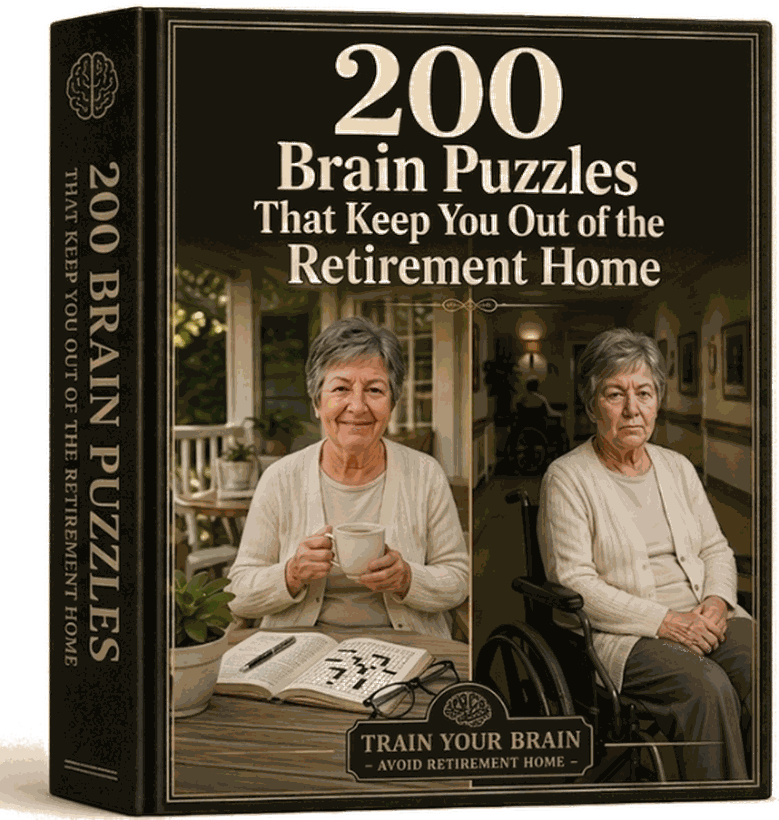
Two books for the second half. One shows you the fifty situations that quietly cost older people their money, their house and their afternoons — and gives you the exact sentence to say in each. The other keeps the ordinary daily skills sharp, because that is what people actually judge you on.
Instant download · Yours forever

“This book is about the difference between being asked and being used, which is a line most of us were never taught to see.”
Grace Holloway · Before You BeginI worked thirty-one years at a small bank in Ohio. Eleven at the teller window, twenty more doing the branch books. In those years I watched a great many careful, intelligent people sign things they did not want to sign.

Almost none of them were fools. They were kind people who had never been given the words. The request arrived, the room went quiet, and they said the only thing they had ever been taught to say.
“It goes: a favor, then a bigger favor, then a favor that was never really a favor, then a Tuesday afternoon where you are watching two children you did not agree to watch, in a house you are paying for, on a card that is not in your name — and you cannot point to the day it started.”
So I wrote one of them: fifty situations, every one of them ordinary, each with what it looks like early, what it actually costs, and the exact sentence to say — written out, short on purpose, so you are not composing it while somebody waits.
The other book came out of the other half of what I saw. The move into a facility is almost never the result of a diagnosis. It is an accumulation. A bill paid late. An appointment missed twice. A daughter visits for a weekend, adds it up, and has a conversation with her brother on the drive home.
So that book works the small competencies that add up to that picture — holding numbers in your head, reading a timetable, finding the word on the first try, remembering a name at the door. Two hundred puzzles, ten parts, a full answer key, and a ninety-day log.
One book protects what you have. The other protects the reason nobody gets to take it. That is why they are sold together.
Ten parts, two hundred puzzles, 146 pages, full answer key.
A field guide for later life — 140 pages, eight sections, fifty situations.
Instant download · Yours forever
Neither one gives you anything to say on a Tuesday afternoon when somebody is standing in your kitchen waiting for an answer.
Nothing here is a summary written for a sales page. This is the table of contents, as printed.

The title is a figure of speech and chapter one takes it apart, on purpose, before you have paid attention to anything else. No puzzle prevents a disease and this book does not pretend otherwise. What it works are the hundred small competencies — the timetable, the change from a twenty, the name at the door — that people quietly add up when they decide whether you are still managing.
Instant download · Yours forever


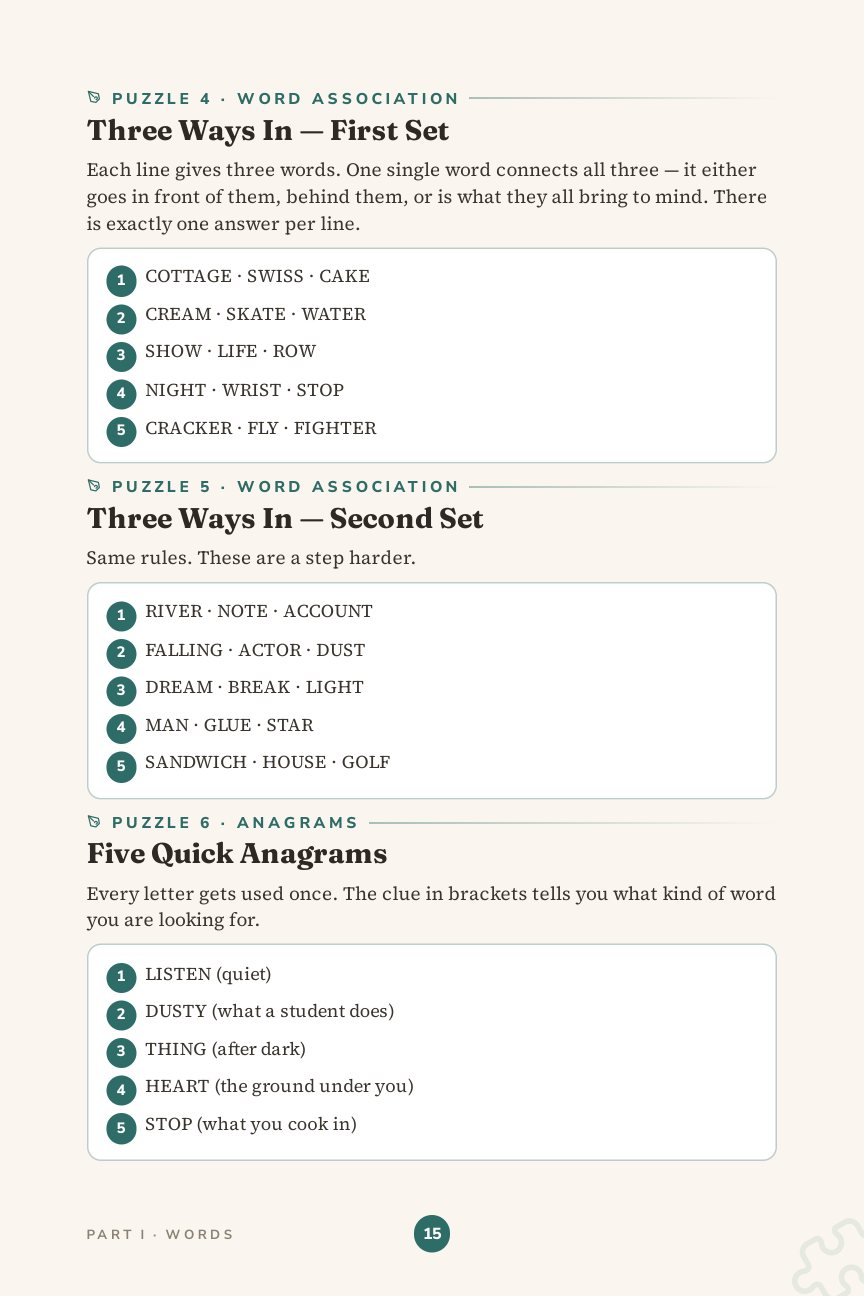
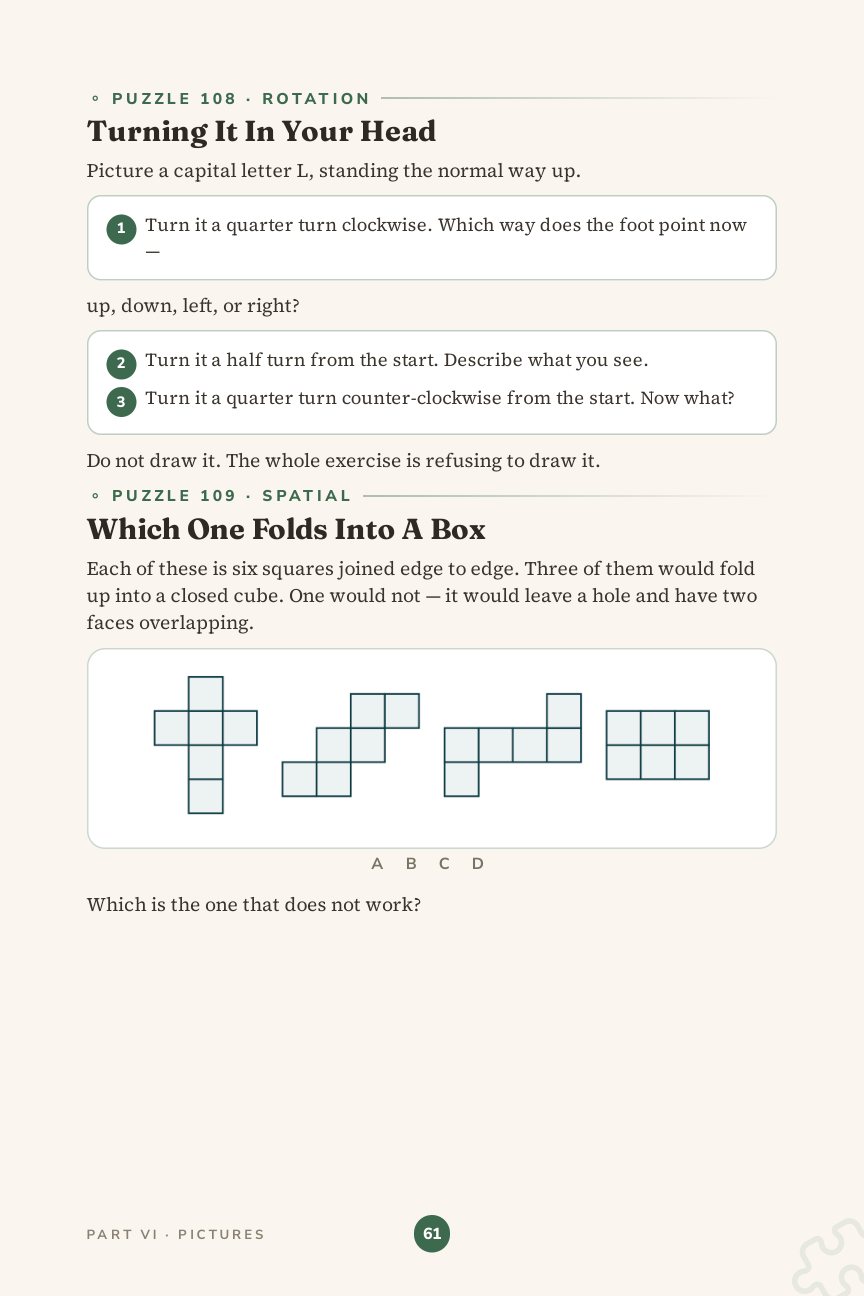
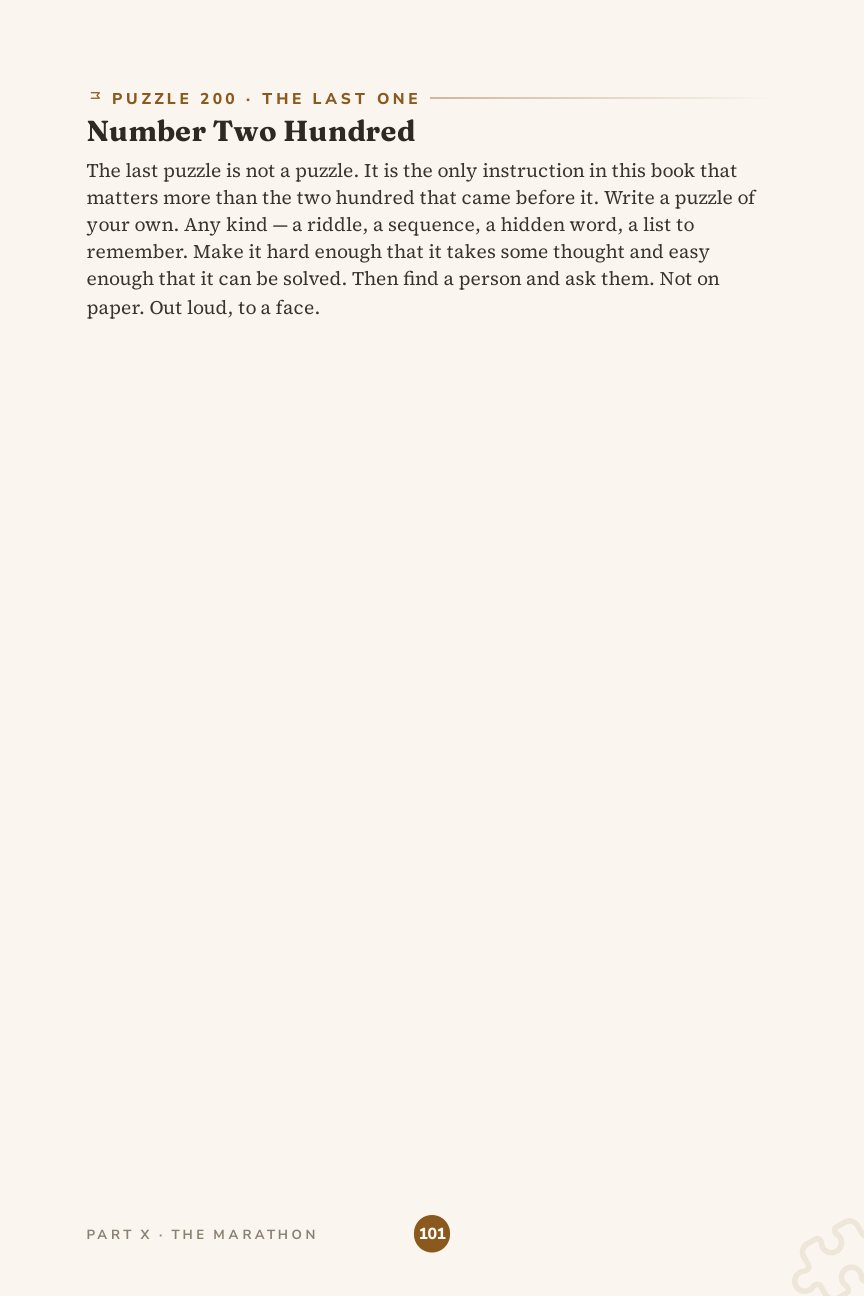
Real pages from 200 Brain Puzzles That Keep You Out of the Retirement Home, illustrated first edition.
Instant download · Yours forever

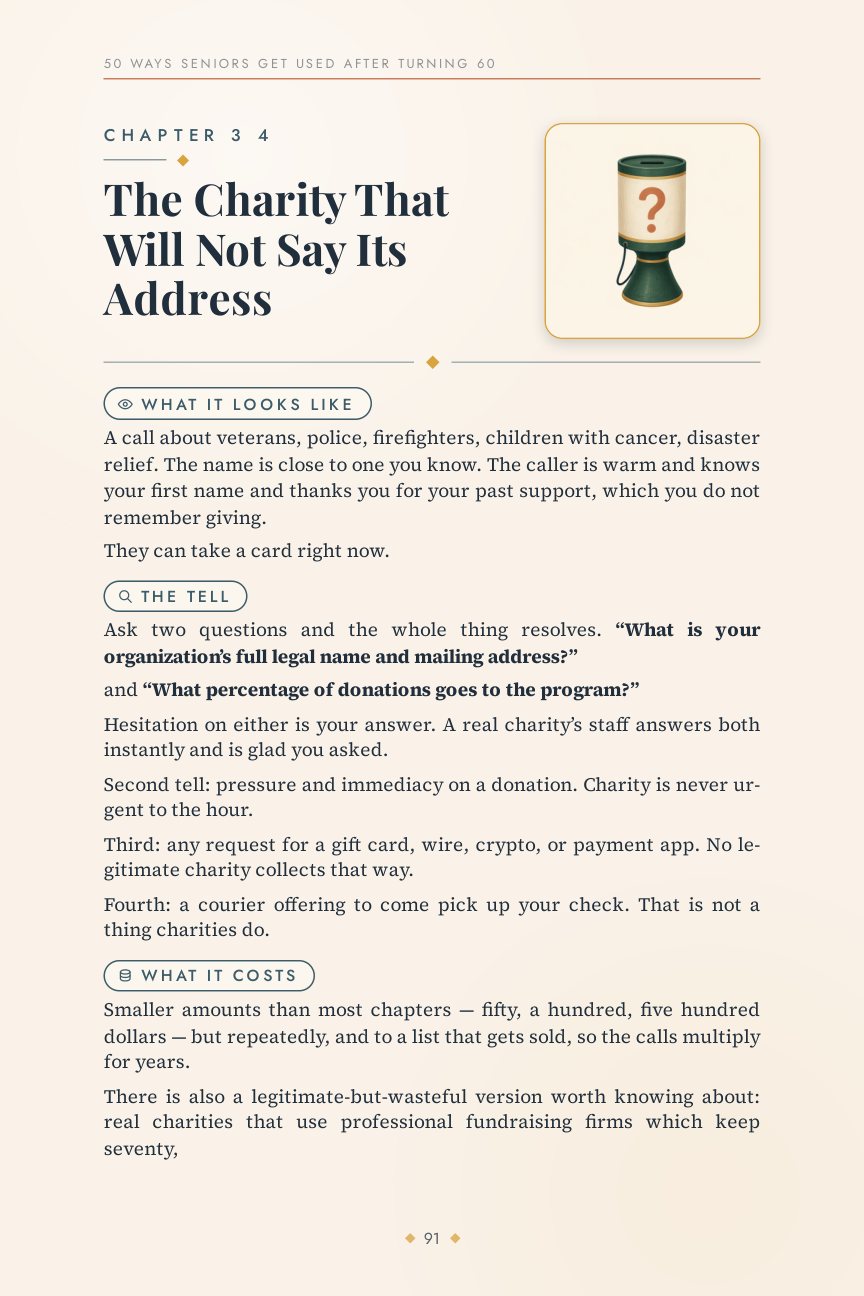
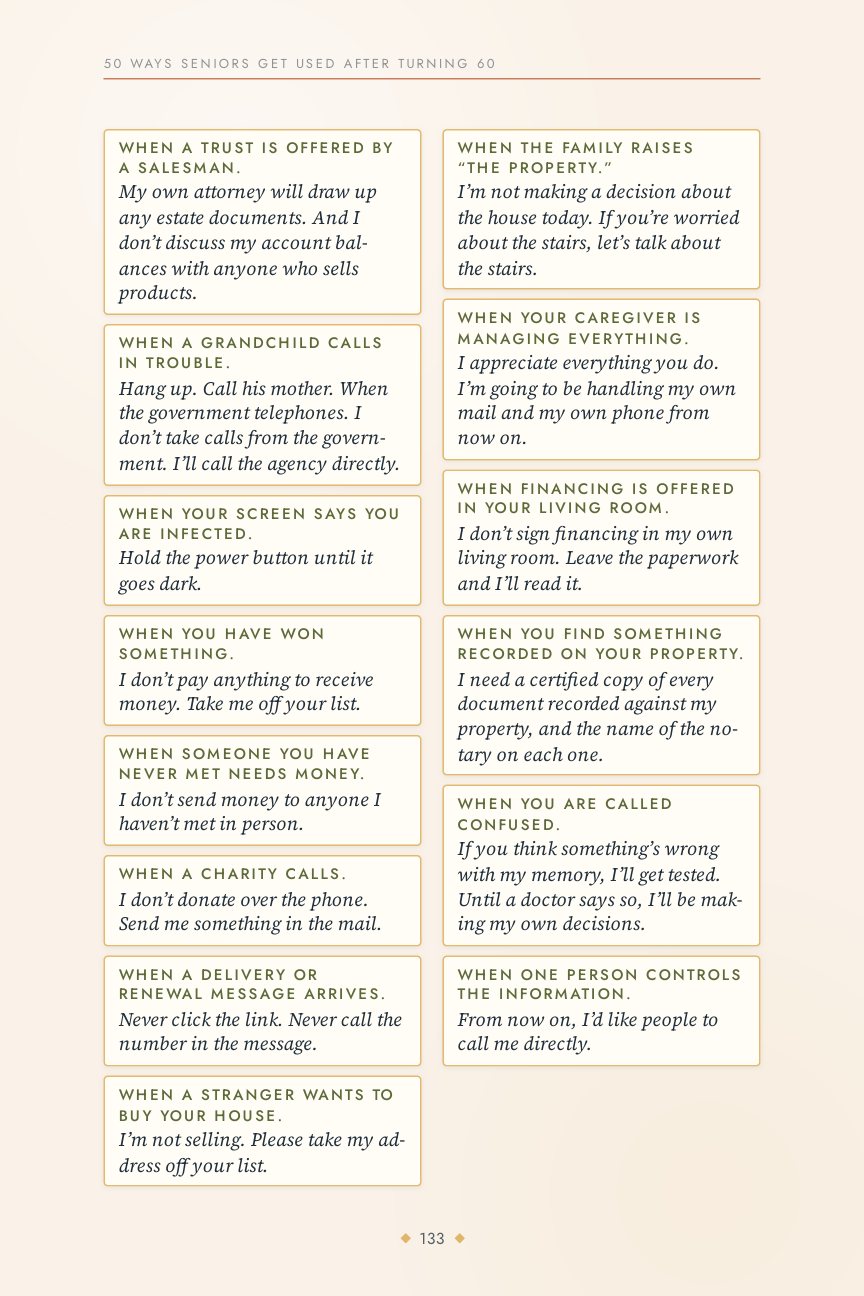
Every chapter is built the same way, so you can find what you need in the middle of the week: What It Looks Like · The Tell · When They Push · What It Costs · The Sentence · The Honest Limit. That last one matters — there are situations in here where the truthful answer is that a book cannot fix it, and I say so.
Instant download · Yours forever


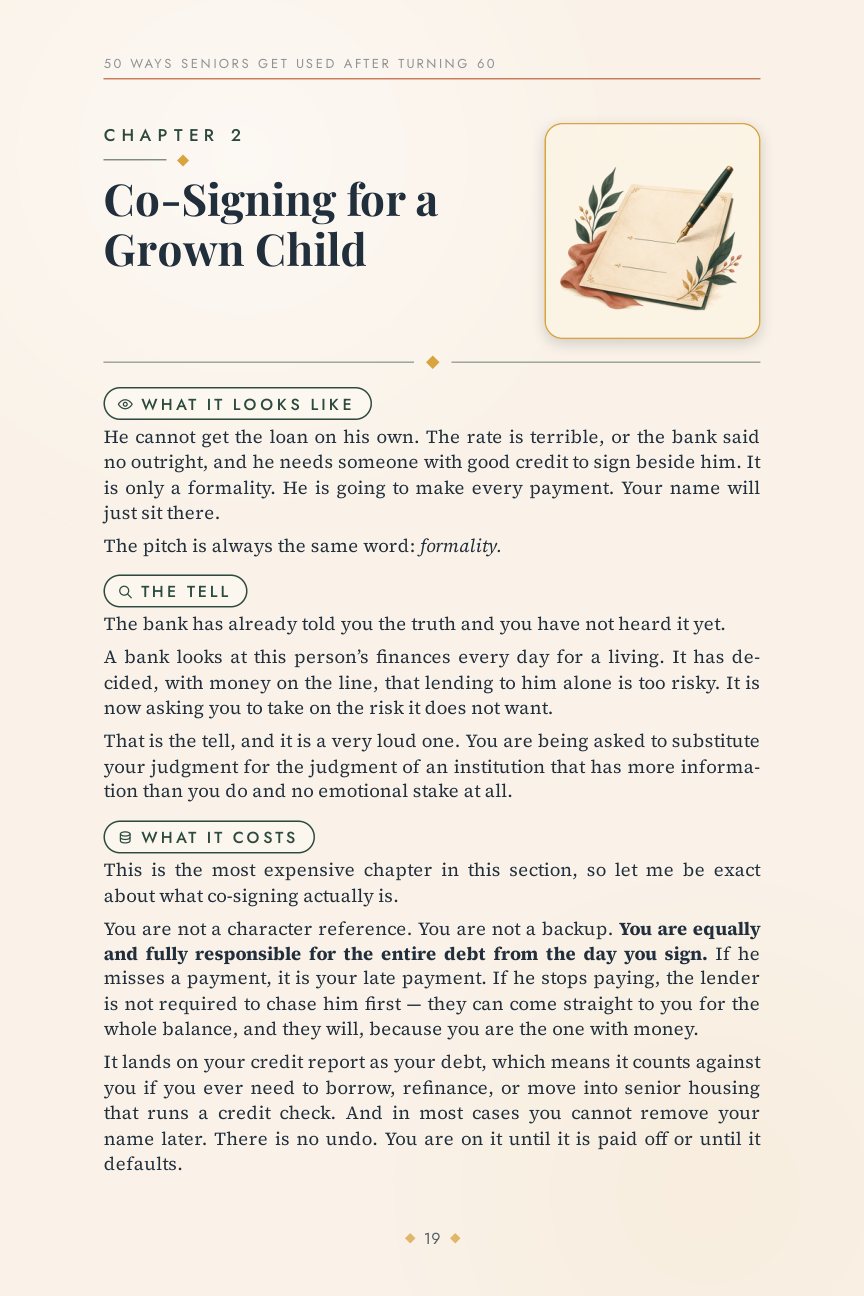
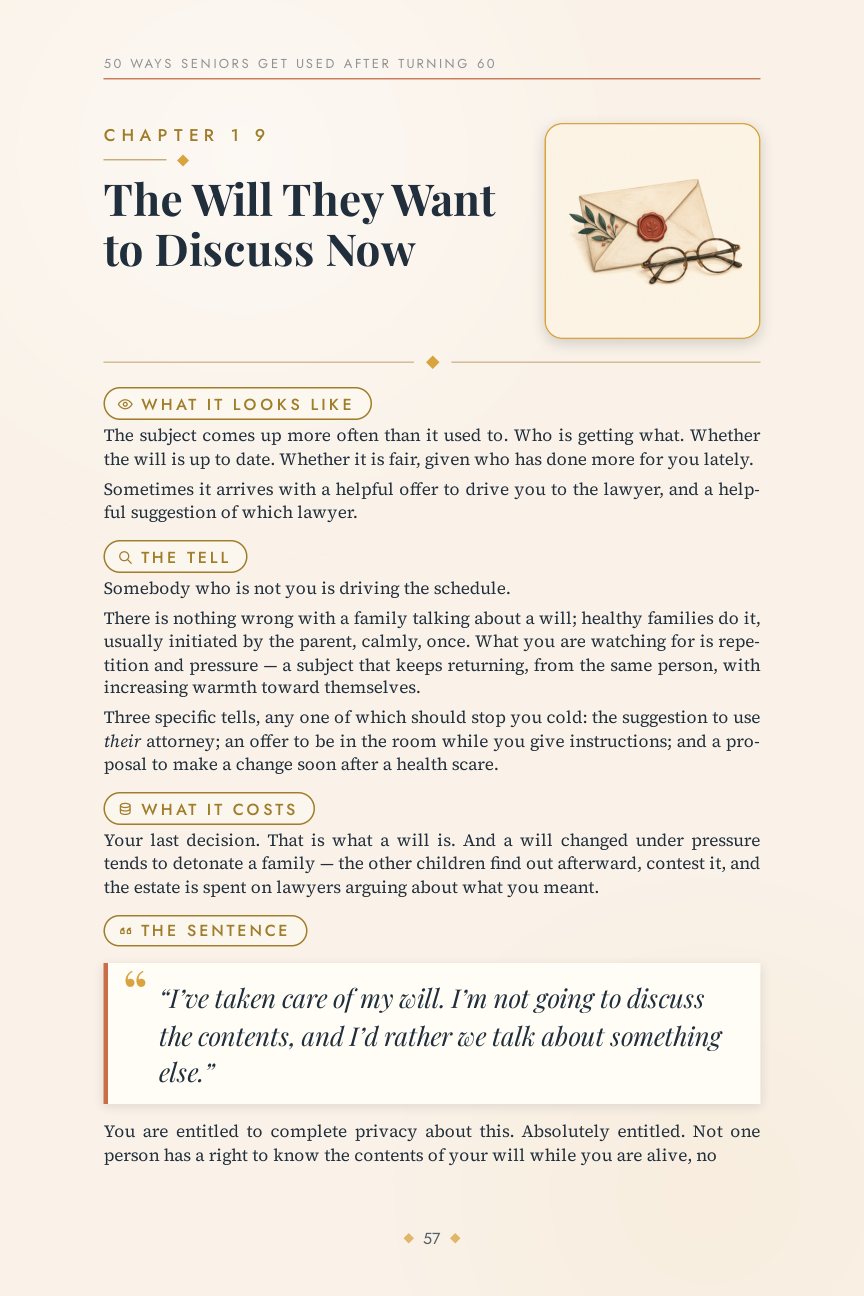
Real pages from 50 Ways Seniors Get Used After Turning 60 And How to Stop Each One, illustrated first edition.
Instant download · Yours forever
“I copied the sentence for co-signing onto an index card and put it by the phone. Three weeks later I needed it. I read it out and my voice did not shake, because I was not making it up.”
Marlene R. · 71“Chapter forty-three is the one that got me. I had not seen my two closest friends in over a year and I could not have told you why. I do now.”
Dorothy K. · 68“Twenty minutes with the puzzles after breakfast, and the log filled in. My daughter noticed before I did. That is worth twenty-seven dollars.”
Raymond T. · 74
I want that said plainly, because it is the first thing people assume. I raised three children. I have seven grandchildren. Two of them stay with me most weekends and I would not trade it for a quiet house. My family asks me for things and I give them things, and none of that is what these books are about.
They are about the difference between being asked and being used — a thin line that moves slowly, and that most of us were never taught to see.
I spent thirty-one years at a small bank in Ohio. Eleven at the teller window, twenty more doing the branch books. I watched a great many people sign things at my counter that they did not want to sign, and almost none of them were foolish. They were kind, and they had never been handed the words.
I also watched something quieter: people who stopped going out, stopped calling, stopped being asked. Section VII of 50 Ways is about that, and it is the section readers write to me about most. Being alone and being managed turn out to be close relatives.
So this is what I do now. I write down the words, and the practice that keeps you able to use them. Nothing here is a system and nothing here is a secret. It is thirty-one years at a counter, written out.
Both books are PDFs. They download the moment you pay, they are yours to keep, and you can read them on a phone, a tablet, a computer, or print them at the library.
Ten parts, full answer key
Instant download · Yours forever
Both books — staying sharp and staying in charge after 60
Instant download · Yours forever
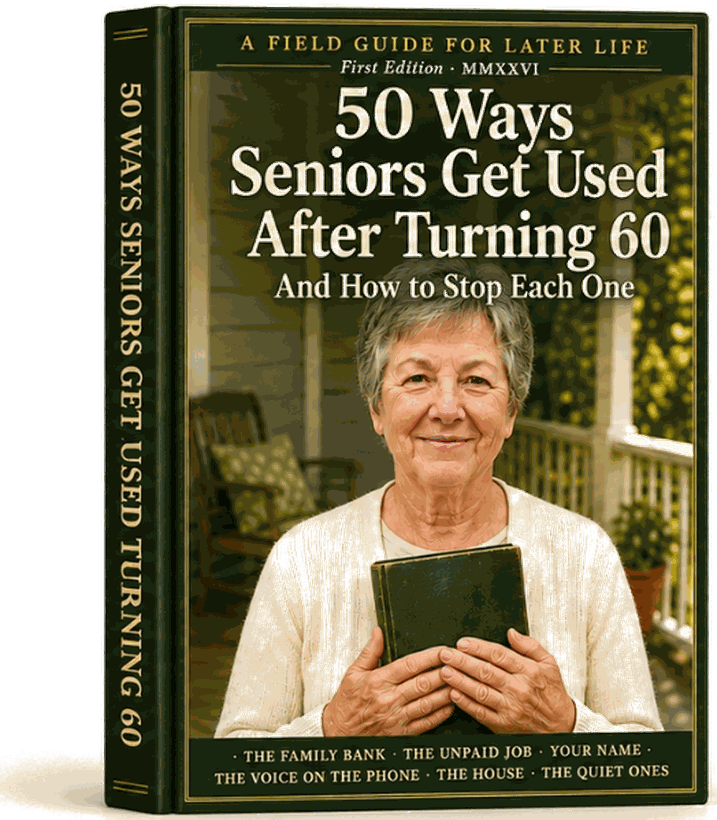
A field guide for later life
Instant download · Yours forever
Secure checkout · Visa · Mastercard · American Express · PayPal
No, and I would not have written that book. Most people are not doing this to anyone. The great majority of families are ordinary and decent, and the great majority of requests you receive are just requests. This is a list of the ways it can go wrong, in the same way a first aid book is a list of the ways a body can be injured — nobody reads one and concludes the world is made of broken bones.
No, and the book says so on its first page before it says anything else. Nothing prevents, treats, slows or detects dementia — not puzzles, not vitamins, not the expensive brain-training program advertised between the afternoon shows. The title is a figure of speech and chapter one takes it apart. What the puzzles work are ordinary daily skills. If you are worried about your memory, make an appointment. That conversation is worth more than every puzzle in the book put together.
Because a video is something you watch once and a book is something you keep by the telephone. The videos take one situation at a time, in whatever order the week suggests. The books take all fifty in order, with the sentence written out for each, plus the sentence book, the ten calls, the phone numbers and the ledger — and two hundred puzzles with the answers and the reasons. It is the difference between hearing a thing and having it in the drawer.
Because the people who need this most are frequently the people who are already giving their money to somebody else. I would rather ten thousand people read it at twenty-seven dollars than four hundred read it at ninety. There is no printing, no shipping and no warehouse — a PDF costs me nothing to send, so the price is what I think is fair and not what the market would bear.
Both are PDFs. They open on a phone, a tablet, a computer or an e-reader, and yes, you can print them — a great many readers print The Sentence Book and the Boundary Ledger and nothing else. The download link arrives the moment you pay, and the files are yours to keep and to copy for your own use.
No. These books are educational and they reflect my own experience from thirty-one years at a bank counter. They are not legal, financial, tax or medical advice. Laws differ by state and change over time, and where a chapter says to speak to an attorney, an accountant or a doctor, please do — the book will tell you which, and what to ask.
Yes. You pay with a card the same way you would anywhere else, and the file appears on the screen with a link to save it. If you would rather, buy it on a grandchild's laptop and have them save it to a folder you can find. There is no app, no account to maintain and no subscription to cancel.
Wait — one thing
Both books together are $47 today — the fifty situations with the sentence for each, and two hundred puzzles with the whole answer key. One of those sentences, said once, has saved readers more than that in an afternoon.
Get the Later Life Collection — $54 $47 or see what's inside →